Loading image...


Ethanol Fireplaces
Create an instant talking point
Because bioethanol is clean-burning, EcoSmart Fire models do not need a chimney or a flue, or a utility connection – offering the ultimate in design simplicity and flexibility.
Whether you're creating a custom fireplace feature, renovating an existing fireplace, or looking for an out-of-the-box solution, we have an ethanol fireplace to suit your needs.
Ethanol Ranges


Loading image...


Environmentally-friendly
Fuelled by eco-friendly, readily available renewable energy – e-NRG bioethanol.
No flue, no chimney
Bioethanol is clean burning so you don't need to flue out any harmful emissions or install costly ventilation systems.
Loading image...


Architectural feature
Bioethanol’s lively dancing flame creates a striking focal point for interior designers.
Loading image...


Design versatility
Easily integrated into bespoke settings – from specially-made cabinetry, media units, walls, floating timber to stone benches and pillars.
The perfect fit
The streamlined design of the products synchronises effortlessly within award-winning architectural projects.
Loading image...

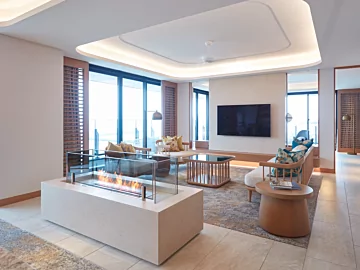 © InterContinental Yokohama Pier 8
 Loading image...


Ventless design
No venting required so ethanol fireplaces fit apartments, renovations, and compact spaces.
Supplemental heating
Add cozy zone warmth with modern fire features to complement your primary heating system.
Powered by e-NRG
Premium liquid fuel engineered for clean, consistent flames with low odour and zero smoke.
Related Collections
Learn More
Ethanol Fireplaces
Bioethanol Fireplaces
Ventless Fireplaces
FAQ's
What is Australia's mandatory safety standard for ethanol burners? (AU)
Clean-burning bioethanol fireplaces in Australia must comply with the Consumer Goods (Decorative Alcohol Fuelled Devices) Safety Standard 2017 (Federal Register reference F2017L00909). Introduced in July 2017 and enforced by the ACCC, it applies in every state and territory and uses the European standard EN 16647:2015 as its technical benchmark.
To comply, a bioethanol device must be permanently fixed, or have a dry weight of at least 8 kg with a footprint of 900 cm² or more. The fuel system must include a flame arrester or an automatic fuel pump, and the unit must carry the prescribed permanent safety warning.
EcoSmart Fire bioethanol fireplaces are built to satisfy this standard, alongside UL 1370 listing and EN 16647 BSI certification.
Do ethanol fireplaces smell?
EcoSmart Fire ethanol fireplaces produce minimal odour during normal operation. You may notice a brief, faint scent when lighting or extinguishing, comparable to blowing out a candle. This is caused by denaturants in the fuel that prevent human consumption. The scent's intensity depends entirely on fuel quality.
EcoSmart Fire fireplaces are engineered exclusively for e-NRG Bioethanol, formulated to 96-97% purity with odour-minimising denaturants that reduce fusel alcohols (compounds creating unpleasant smells in lower-grade fuels) to barely perceptible levels. Using other fuels may affect performance and warranty coverage.
If you ever notice an unusual smell, the fix is straightforward: ensure you're using e-NRG Bioethanol and that the burner is clean and debris-free. Once properly fuelled, the smell will not return.
What are the pros and cons of ventless fireplaces?
Ventless bioethanol fireplaces deliver room-vented performance without any of the infrastructure traditional installations require. There is no chimney, flue, or gas line, and combustion is clean, producing no smoke, soot, or ash. The gains are real: heat stays in the room rather than escaping through a flue, and the fireplace can be positioned almost anywhere, from apartments to open-plan living spaces. Managing the trade-offs is equally clear. Bioethanol combustion consumes oxygen, so the room must meet manufacturer-specified minimum volumes, and ventilation needs to remain adequate during use. These fireplaces are designed for supplemental heating, not as a primary heat source, and they require ongoing refuelling since no fuel line connects them. For spaces where a traditional fireplace is impractical, the room-vented ventless format offers genuine design freedom. The cost of that freedom is active fuel management and attention to room conditions during operation, both of which are clearly outlined in EcoSmart Fire's product documentation and third-party certified safety standards.
Are there any building codes or regulations for ventless fireplaces?
As a room-vented design, ventless bioethanol fireplaces are regulated under product safety standards (UL 1370, EN 16647, ACCC) rather than traditional building codes that govern gas or wood-burning installations. EcoSmart Fire ventless fireplaces meet these safety standards and require no chimney, gas lines, or electrical hookups, which eliminates many code compliance complexities. Because bioethanol combustion produces no smoke or harmful emissions, ventless fireplaces bypass venting and structural requirements that apply to conventional fireplaces.
Regulations do vary by jurisdiction, so we recommend consulting your local building authority during the design phase to confirm any region-specific requirements for your project. Key installation specifications, such as 600 mm [23.6 in] clearance from combustibles and adequate room volume (typically 40–110 m³ for most residential models), are designed to ensure safe operation and are integrated into all EcoSmart Fire product documentation.
The ventless design simplifies the approval process because it eliminates the need for multiple trades (gas fitting, electrical, ventilation) and their associated code pathways. This makes ventless fireplaces particularly practical for retrofits, multi-residential applications, and properties where traditional fireplaces aren't viable.
Are bioethanol fireplaces environmentally friendly?
Bioethanol fireplaces are environmentally friendly in ways that go beyond zero emissions. They produce no ash, soot, or residue, leaving nothing to dispose of, and their ventless design eliminates the environmental cost of infrastructure like chimneys, flue systems, or gas plumbing. The fuel comes from renewable agricultural byproducts: sugarcane, corn, grain, and beetroot.
Because combustion releases only the CO2 that the crops absorbed during growth, the fuel cycle is carbon-neutral. When combined with the fireplace's design durability and longevity, a bioethanol fireplace becomes a low-impact choice for years of use. EcoSmart Fire products meet international safety standards (UL 1370-16, EN 16647) and carry sustainability certifications across manufacturing, reinforcing the brand's commitment to responsible production.
Do bioethanol fireplaces need a chimney or flue?
Bioethanol fireplaces with adjustable flame control do not require a chimney, flue, or permanent ventilation system. The clean combustion of bioethanol releases only water vapour and a small amount of carbon dioxide, with no smoke or soot that would need extraction through a dedicated exhaust pathway.
What replaces the chimney is adequate room volume and natural air infiltration. Minimum room sizes are specified per burner. In very compact rooms, a window openable to 25 mm [1 in] or an adjacent open door provides sufficient air exchange.
This chimney-free design underpins the installation freedom EcoSmart Fire bioethanol fireplaces are known for: zero-clearance inserts, freestanding pieces, and existing fireplace conversions all become viable without structural works.
What are the environmental benefits of ventless ethanol fireplaces?
Room-vented bioethanol fireplaces deliver multiple environmental benefits that begin with the fuel itself. Bioethanol's carbon profile is fundamentally different from fossil fuels: the CO2 released during combustion is equivalent to what the source plants absorbed during photosynthesis, cycling existing atmospheric carbon rather than releasing sequestered fossil carbon. The bioethanol used in EcoSmart Fire fireplaces is derived from agricultural by-products and surplus crop production, positioning it as a renewable resource rather than a dedicated energy crop.
Combustion produces only CO2 and water vapour, leaving zero particulates, soot, ash, or harmful gases. Unlike vented fireplaces that lose heat up a chimney, the room-vented design retains all combustion heat within the space, reducing the fuel needed to achieve the same comfort level compared to traditional wood or gas alternatives.
The absence of flue infrastructure eliminates ongoing environmental costs: no chimney maintenance, no structural engineering for venting systems, and no dependency on gas supply chains or electricity grids powered by fossil fuels. From production to operation to end of life, bioethanol fireplaces offer a resource-efficient alternative aligned with sustainable design principles.
Are ventless fireplaces safe?
Ventless bioethanol fireplaces from EcoSmart Fire are safe when properly installed and operated according to guidelines. Unlike gas ventless fireplaces, bioethanol produces only water vapour, heat, and CO2 (comparable to a burning candle), with no carbon monoxide, smoke, soot, or harmful gases. EcoSmart Fire units include integrated safety features: a manual shut-off system, safety glass windscreens, and flame arrestor fuel bottles designed to minimise spill risk. Independently certified to UL 1370-16 and EN16647, the brand has deployed thousands of units across luxury hotels, resorts, and multi-residential buildings globally for over two decades. Proper room sizing and adequate ventilation are essential; refer to product specifications for your model's requirements.
How much heat does a bioethanol fireplace produce?
Bioethanol fireplace heat output from EcoSmart Fire ranges from around 2 kW (6,180 BTU/h) for a compact burner to 13 kW (45,870 BTU/h) for a large multi-burner configuration, with efficiency greater than 90%. Because these fireplaces are ventless, no heat escapes up a flue, so all thermal output stays in the room.
Output scales with burner size and room volume:
- Compact burners: 2 kW (6,180 BTU/h), suited to spaces from about 15 m2 [161 ft2]
- Mid-range burners: 3 to 4 kW (11,430 to 15,290 BTU/h), covering 40 to 65 m2 [431 to 700 ft2]
- Large multi-burner Flex layouts: up to 13 kW (45,870 BTU/h), covering up to 195 m2 [2,099 ft2]
Adjustable-flame models let you modulate the output below maximum, and a single fill delivers 7 to 14 hours of burn time depending on flame height. Configured to the space, an EcoSmart Fire fireplace adds immediate, ambient warmth as a sculptural focal point. Output varies with flame height setting and installation configuration.
Do bioethanol fireplaces need electricity to operate?
No, bioethanol fireplaces do not need electricity to operate. EcoSmart Fire bioethanol fireplaces run purely on liquid bioethanol fuel, with no power cord, no gas line, no flue, and no utility connections required.
That independence opens placement options a traditional fireplace cannot match. Without hardwired services, the fireplace can sit centred on a freestanding wall, inside bespoke joinery, on an apartment balcony, or anywhere a traditional fireplace simply can't go. Ignition is manual using the supplied Lighting Rod or Fire Lighter, a refillable butane wand, and the flame is adjusted by hand at the burner.